 pokerglobal
Is it really possible to earn money playing freerolls? Or how Chris Ferguson started with freerolls an earned more than $120.000
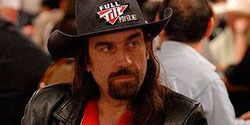
The experiment, were Chris Ferguson was trying to prove to entire poker community that it is really possible to build up a $10.000 bankroll out of nothing, took him about 18 months.
Poker is just practical mathematics! - Chris Ferguson
First, we will try to explain in brief who Chris Ferguson is
Chris Ferguson - brief info:
- Full name: Christopher Philip Ferguson
- Poker nickname: Jesus
- Date of birth: 11.04.1963
- Place of birth: Los Angeles, California, the USA
- Lives in Los Angeles, California, the USA
- $7,500,000 winnings in poker tournaments
- 5 WSOP gold bracelets
Christopher Philip Ferguson was born on the 11th of April, 1963, in Los Angeles, California, the USA. The parents of a future professional poker player and one of the biggest poker room’s co-founder are mathematicians who earned a reputation and academic degree, so nobody ever doubted Chris to become a famous mathematician.
At the age of 18 Chris entered the University of California in Los Angeles. He spent 18 years at the university: 5 of them as a student and 13 more as a professor, teaching students higher mathematics and mathematical statistics as a graduate.
In 1999, when Chris turned 35, he earned a Ph.D. in computer science and left the university for his college hobby - poker.
Chris Ferguson is one of the crucial persons who played an important role in the evolution, development and promotion of online poker and poker in general. As it was already mentioned, he is one of the Full Tilt founder.
Chris is also an author of several books on poker tournament strategy: 'The Full Tilt Poker Strategy Guide: Tournament Edition' and 'Little Blue Book: More Lessons and Hand Analysis in No Limit Texas Hold'em'.
Chris Ferguson’s challenge
Chris had only one goal - to earn $10 000 with $0-investment and then donate his winnings to “Save the Children Foundation”.
Chris was playing freerolls until he earned enough money to play with real money poker games. Chris had strict bankroll management: he never registered for Sit-n-Go tournaments in case the entry fee was more than 5% of his bankroll, except for low-limit tournaments. What concerns MTT - his registration limit was 2% of his bankroll, except for MTTs with $1 buy-in.
But beginning is always the toughest part: it took him 7 months to earn $6,50 and his bankroll was very volatile. Then Chris made a huge step up, when he registered in a tournament with $1 buy-in and was runner-up (out of about 680 participants) with $104 winning. Next 6 months he played inexpensive one-table tournaments (Sit-n-Gos), boost his bankroll up to $500 and started playing at the cash-tables. It took him 8 months more to achieve his goal and earn $10.000.
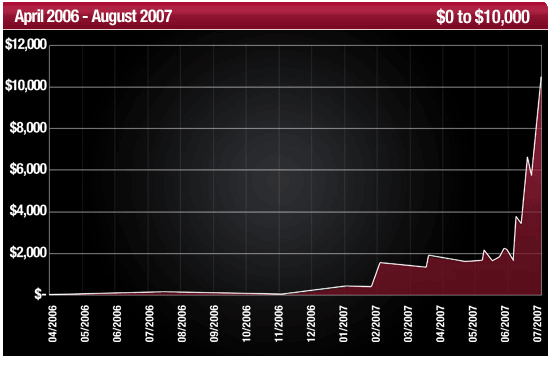
Chris Ferguson - from $0 to $10000. Graph since April, 2006 to August, 2007
Due to his MTT success, Chris crossed a new border line - $750. Then, when he played cash games, his bankroll ‘faced little troubles’ and was reduced to $605. But on 11-12 July he earned more than a thousand dollars playing cash and turned out to be a finalist of three MTTs with a $5 entry fee. Thus, he earned $2756 by the 22th of July. Since then he gained a thousand every day (he had $5,538 on July, 26) and came very close to the finish line by the 3d of August - $9576,34. At 10 a.m. on the 14th of August Chris reached a desirable destination - $10041,34, but the session wasn’t over and he participated in a few more tournaments. At last, his final achievement was $13813,7. The experiment was completed successfully. As he had promised, Chris donated $10,000 he earned playing poker to “Save the Children Foundation”.
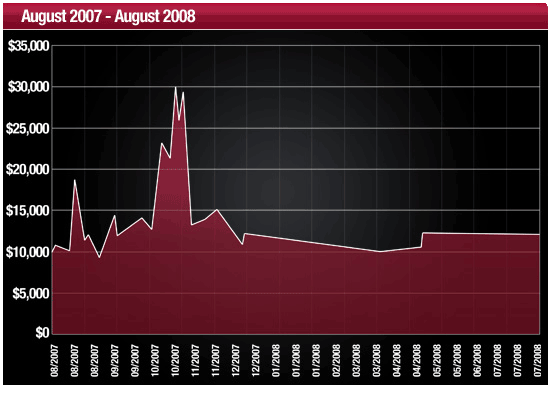
Chris Ferguson - the way from $0 to $10000. Graph since August, 2007 to August, 2008.
The next year
After he gained his primary objective - to boost his bankroll from 0 and turn it into $10000 - Chris decided to set one more goal: to multiply this $10000 tenfold.
Full Tilt founder reached $30,000 bankroll and then faced a tough downstreak. His bankroll was $10000 again.
From $0 to $10.000 and to $100.000+
But the downstreak wouldn’t stop him: he carried on playing and approaching his goal. Chris was the fifth in the FTOPS XVII Event#13 series and earned $68 854 - his bankroll raised beyond $100,000.
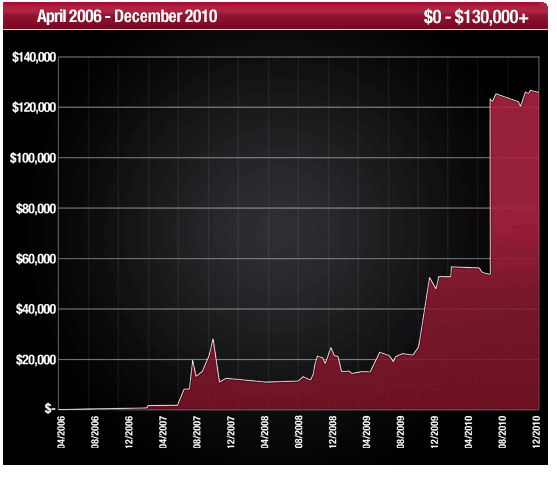
Chris Ferguson - from $0 to $10,000. Graph since April, 2016 to December, 2010.
To learn more how to turn skills and patience into thousand dollars, note Chris’ professional view on how to manage a bankroll.
Remember: you risk your bankroll if you play in cash games or a tournament with buy-ins, which you can’t afford. But if you make a plan of a game and play reasonably, you will be able to survive any bad beat or downstreak. Chris Ferguson knows this for sure, he has proved this rules work.
You can see Chris’ bankroll challenge interview to one of the poker resources below.
Q: What was the toughest thing about the challenge?
- The very beginning, I suppose. It took me about 6 months to build a bankroll that would fit playing with real money poker games. And it was also really hard to stick to the rules and control myself during the experiment.
Q: Did funny and amusing things happen to you?
- One of the funny things about the challenge was that people would see me playing at low stakes and thought I was fooling around: «Chris, is it really you? What are you doing here? Why are you playing these stakes?»
Q: What can you advice to the poker beginners so that they could set goals and achieve it successfully ?
- I can specify some rules I followed during the challenge. Don't play cash games or Sit-n-Go tournaments with buy-ins more than 5% of your current bankroll and MTT with more than 2% of your bankroll. Quit the game when your stake is more than 10% of your bankroll while playing cash. And in case a poker game is not going well and you admit that you're playing bad today, make a break. It helps often to reconsider the game and set new goals.
'One day in poker is 90% luck and 10% skills, but one year in poker is 10% luck and 90% skills'.
Chris Ferguson, WSOP 2005 winner.
The best about poker
- How to get satisfaction from playing poker
The psychology of poker
- Five reasons why I've made money and continue doing this playing poker
The psychology of poker
- Poker table positions (positions in poker)
Fundamentals of poker
- The fundamental theorem of poker
Poker theorems
- Slow play in poker
Fundamentals of poker
- The probabilities of getting specific starting hands on preflop
Poker mathematics
 Gambling can be addictive. Play responsibly



Comments (0)